


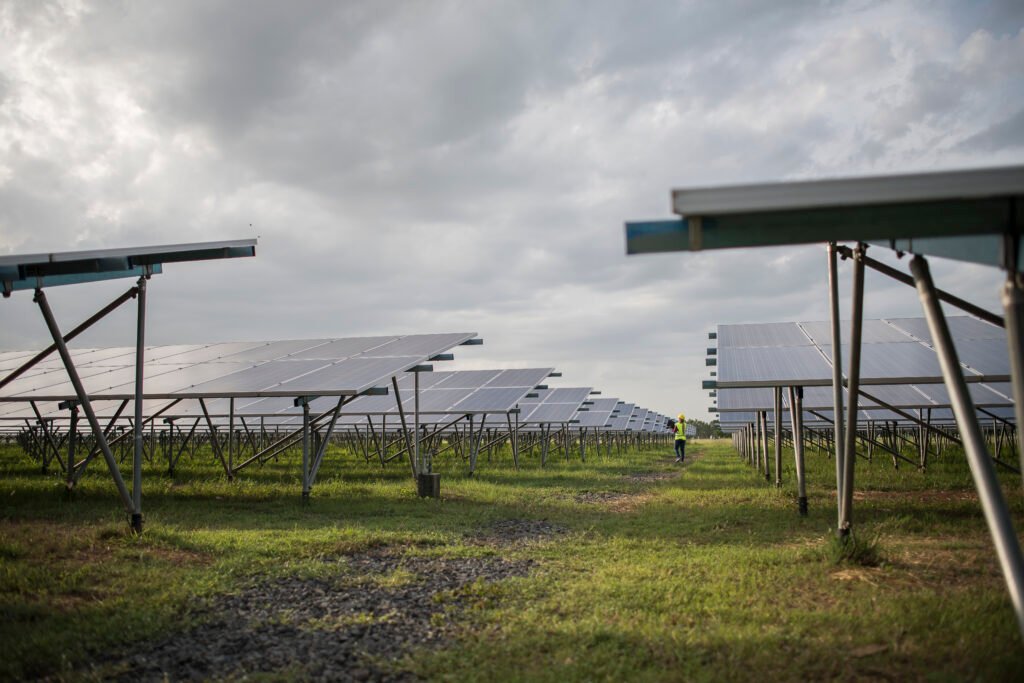
As Mauritius moves toward the Government’s target of 60 % renewable energy by 2035, the Central Electricity Board (CEB) has introduced the Agrivoltaics (CAV) II Scheme. The programme enables hybrid solar PV projects with battery storage to be developed on agricultural land, allowing electricity generation while farming activities continue.
Unlike the first agrivoltaics scheme, which focused on small projects below 500 kW, CAV II is designed for registered farmers and planters undertaking projects between 500 kWac and 4 MWac. This guide outlines why the scheme was introduced, who can apply, and how it works.
Why a Second CAV Scheme?
The initial CAV scheme launched in 2024 laid the foundation for agrivoltaics in Mauritius but was limited in scale. Feedback from stakeholders and concerns around grid stability led the CEB to introduce an enhanced framework.
The CAV II Scheme, officially launched on 2 December 2025, expands the scope to:
- Support medium-scale hybrid solar projects
- Strengthen energy and food security
- Reduce grid intermittency through mandatory battery storage
A total capacity of 40 MW for Mauritius and 2 MW for Rodrigues has been earmarked. Applications are accepted only from registered farmers and planters, in line with national energy and climate objectives.
Main Goals and Benefits
CAV II promotes the dual use of land, allowing agricultural production and solar generation to coexist. This approach addresses land constraints while maintaining farm productivity.
For participating farmers and planters, the scheme offers:
- Long-term electricity sales to the CEB
- Income diversification alongside agricultural activity
- The option to form cooperatives, benefiting from economies of scale
At a national level, CAV II supports reduced emissions from agriculture and contributes to Mauritius’ long-term sustainability goals.
Key Features of the Scheme
Capacity and Project Size
- Eligible project size: 500 kWac to 4 MWac
- Maximum export at Point of Delivery: 2 MWac
- Final approved capacity: Determined following a Network Impact Assessment (NIA) or Network Survey (NS)
- Capacity allocation: First-come-first-served, subject to grid availability
Mandatory Battery Storage
All CAV II projects must be hybrid systems and include battery energy storage sized for:
- At least four hours at 50 % of AC output
The battery system must be flexible, reprogrammable, and dispatched according to CEB requirements. This is a core condition of the scheme.
Export Tariff
CAV II operates under the gross-metering principle, with export remuneration structured as follows:
- Rs 6.21 per kWh for energy stored and dispatched in accordance with CEB instructions
- Rs 5.00 per kWh for energy exported without storage
Where applicable, a weighted average tariff applies depending on the proportion of stored and non-stored energy.
Self-Consumption and Commissioning
Developers may offset electricity imported from the CEB for operating the agrivoltaics facility. Grid connection and commissioning are carried out sequentially, based on project readiness.
Milestones and Timelines
For projects between 500 kW and 2 MW, key milestones include:
- Signing of Connection Agreement: within 1 month of Letter of Intent
- Securing permits: 2 months after signing
- Proof of equipment order: 3 months after permits
- Construction start: 2 months after proof of order
- Commissioning: 4 months after construction start
Projects above 2 MW are subject to extended timelines. Projects that fail to meet milestones may be deferred or placed on hold.
Eligibility
Applicants must:
- Be registered farmers or planters
- Apply for one project only
- Have no active litigation with the CEB
- Hold no other CEB renewable-energy contract under the same electricity account
- Apply individually or through a duly registered cooperative
How to Apply
- Download the application form from the CEB website
(Applications accepted from 15 December 2025) - Submit the application at a CEB Customer Services Centre
A complete submission and non-refundable processing fee are required. - Receive a Letter of Intent (LoI)
Successful applicants must sign the Connection Agreement within the specified period. - Complete permits and network studies
Final approval is subject to NIA/NS outcomes and full compliance.
Metering and Compliance
- Import/export meters are supplied and maintained by the CEB
- Metering costs are borne by the developer
- Developers must provide access to generation data and allow inspections
- Any tampering results in disconnection and termination of the agreement
Why CAV II Matters
CAV II enables farmers and planters to:
- Generate clean electricity at scale
- Maintain agricultural activity on the same land
- Participate directly in Mauritius’ renewable-energy transition
With limited national capacity and strict milestones, early and well-prepared applicants are best positioned.
Why Partner with Enovra Energy Solutions?
Enovra Energy Solutions provides end-to-end support tailored to the Mauritian context, including:
- Agrivoltaics and CEB process expertise
- Hybrid PV-battery system design and engineering
- Application, permitting, and URA licensing support
- Advisory on financing and cooperative structuring
- Long-term operation and maintenance services
By partnering with Enovra, farmers and planters can focus on agriculture while experienced professionals manage the technical and regulatory requirements.
Ready to Proceed?
Confirm your eligibility, prepare early, and seek expert guidance.
Contact Enovra Energy Solutions to discuss feasibility assessments or turnkey EPC services for your CAV II project.