


1. A Global Energy Shock Mauritius Cannot Ignore
At the time of writing this article, in March 2026, the world is facing a serious energy shock linked to the conflict involving Iran. The disruption has hit oil and gas supply routes, pushed prices higher, and reminded import-dependent economies how quickly global energy markets can become unstable.
For Mauritius, this matters immediately. As a small island economy that still depends heavily on imported fossil fuels, the country remains exposed to external price spikes, shipping disruptions, and supply-side uncertainty. We cannot bury our heads in the sand and assume everything around us will remain normal.
The lesson is simple: gouverner, c’est prévoir. In energy, anticipation means building resilience before the next shock arrives. That is why solar energy in Mauritius is no longer just an environmental discussion. It is an economic, strategic, and national security discussion.
2. The Audit Report Says What Many Already Suspected
The latest press reporting based on the national audit findings paints a worrying picture. Mauritius has stated ambitious renewable energy goals, yet several strategic energy projects have experienced significant delays, slow implementation, or remain stuck at preliminary stages.
Among the most striking findings, the planned installation of 10 MW solar systems every three years was only partially delivered, with only a handful of projects completed in 2018, 2024 and 2025. Other major initiatives, including the 60 MW Stor’Sun hybrid plants, the 14 MW solar project at the airport, and the Amaury storage system, have progressed slowly or remain underdeveloped.
The article also highlights delays or blockages affecting 33 MW of solar production and infrastructure such as GIS substations. In other words, Mauritius does not lack ambition on paper. It is struggling on execution.
Key points raised by the audit reporting
• Repeated delays on utility-scale renewable projects that were meant to strengthen the national energy mix.
• A roadmap that requires major capital deployment, but no sufficiently structured and dependable financing mechanism.
• Weak institutional coordination, including leadership gaps at MARENA.
• Persistent infrastructure inefficiencies, including treated water losses of up to 200 million m³ per year, pointing to broader structural weaknesses.
3. Mauritius Has Solar Potential — But Potential Is Not Delivery
Mauritius is one of the most naturally advantaged markets for solar energy in the region. The island enjoys more than 250 sunny days per year, has a clear national need to reduce fuel imports, and already has regulatory pathways for both residential and commercial solar projects.
Yet solar potential alone does not change an energy system. Delivery does. The audit-related reporting is important precisely because it exposes the gap between what the country says it wants and what is actually being commissioned on the ground.
This is where the national conversation needs to mature. The issue is not whether solar farms are good or bad. They are necessary. The real issue is whether Mauritius can rely on large, slow-moving projects alone while the pressure on the energy system keeps rising.
4. Solar Farms Matter — But They Are Not the Whole Solution
Large solar farms and hybrid plants are essential for the long-term transformation of the grid. They add meaningful capacity, improve planning visibility, and help shift the national generation mix away from imported fuels.
But they also come with long development cycles, financing complexity, procurement hurdles, land questions, grid integration constraints, and institutional dependencies. In a period of global volatility, Mauritius cannot afford to wait only for large projects to arrive.
This is why the right position is not to discourage solar farms. The right position is to say clearly: utility-scale projects are necessary, but by themselves they are not enough, and they are not moving fast enough to solve the immediate energy challenge.
5. The Missing Piece Is Distributed Solar Energy in Mauritius
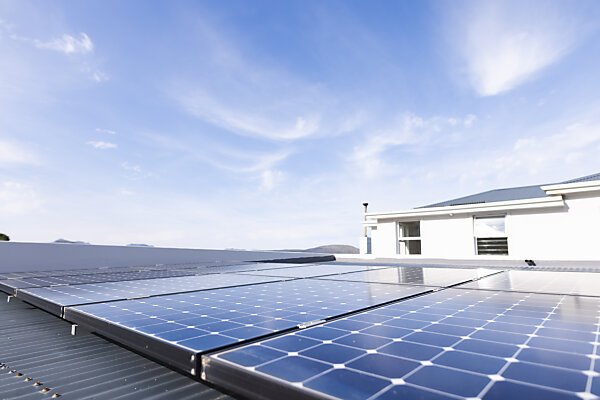
If Mauritius wants faster impact, it needs a second track running in parallel: distributed solar. That means residential rooftop systems, commercial solar installations, hybrid solutions with battery storage, and faster adoption across homes, offices, factories, schools and institutions.
Distributed solar has three major advantages. First, it can be deployed much faster than large utility projects. Second, it reduces pressure on the national grid by producing electricity closer to where it is consumed. Third, it gives households and businesses direct protection against rising electricity costs.
This is why solar installation in Mauritius must not be seen only as a private purchasing decision. It is also part of the country’s resilience strategy. Every rooftop system installed is one small step away from fuel dependence and one step closer to energy independence.
Why distributed solar deserves more urgency
• It helps households cut electricity bills and hedge against future tariff pressure.
• It allows businesses to stabilise operating costs and improve competitiveness.
• It creates faster momentum than waiting exclusively for a few large projects.
• It supports the national transition by spreading generation capacity across the economy.
6. What the CEB Framework Already Makes Possible
Mauritius already has pathways that support solar adoption. Under the CEB domestic scheme, households can install solar PV systems and connect them to the grid. The CEB communiqué of 14 August 2024 increased the maximum allowed capacity for domestic PV installations from 5 kW to 15 kW, with applications up to 10 kW following the standard procedure and systems above 10 kW requiring a network survey. The domestic scheme documentation also states that the tariff for energy produced under the scheme is MUR 3.73 per kWh.
For non-domestic customers, the CEB’s revised tariff notice confirms MUR 4.20 per kWh for qualifying MSDG exports under the relevant schemes. These are not abstract policy ideas. They are practical frameworks that can support real solar deployment right now, provided businesses and households are guided properly through the process.
7. Where Enovra and Servotech Fit Into This Story
Enovra’s role should be positioned clearly and confidently. Mauritius does not just need more discussion about renewable energy. It needs execution. That is exactly where Enovra can differentiate itself.
As Enovra’s brand profile makes clear, the company is built around accessible, reliable and high-quality clean energy solutions for Mauritian households and businesses. Through its partnership with Servotech, Enovra brings world-class solar panels, inverters, batteries and clean-energy technologies to the local market, backed by local service and execution capability.
This matters because in a market where national projects are delayed, trust will increasingly shift toward companies that can actually deliver. Enovra should therefore position itself not as a commentator on the energy transition, but as an implementation partner helping Mauritius move faster.
Why choose Enovra for solar in Mauritius
• Local execution with a clear Mauritian market focus.
• Access to Servotech technology across solar panels, inverters, storage and clean-tech solutions.
• A turnkey model covering design, installation, documentation and after-sales support.
• A brand proposition built around energy independence, affordability and dependable service.
8. What Each of Us Can Do Now
The transition will not be won only by ministries, boards and utility-scale developers. It will also be shaped by the decisions made by homeowners, businesses, developers and institutions.
That is why this conversation must end not only with criticism, but with action.
For homeowners
• Consider rooftop solar panels if your property is suitable.
• Think beyond monthly savings and see solar as protection against future energy volatility.
• Use the current CEB framework while capacity and incentives remain available.
For businesses
• Assess commercial solar seriously as a cost-control tool, not a branding extra.
• Use solar energy in Mauritius as a hedge against imported energy exposure.
• Combine solar with battery storage where resilience is business-critical.
For developers and institutions
• Integrate solar at design stage rather than treating it as an optional add-on.
• Prioritise projects that can move quickly and produce measurable impact.
• Support a broader culture of decentralised, practical renewable adoption.
9. Final Thought: The Audit Report Should Start a More Honest Conversation
The problem with Mauritius’s energy transition is not a lack of speeches, targets or ambition. The problem is pace. The audit-related reporting is valuable because it forces the country to confront this reality honestly.
Solar farms must continue. Strategic infrastructure must be delivered. Institutional coordination must improve. But at the same time, solar panels in Mauritius must move much faster at the household and commercial level. That is where immediate momentum can be built.
In a world shaken by an energy crisis, the countries that will be strongest are those that prepare early. Mauritius still has the chance to do so. But preparation now requires action — not later, not eventually, and not only in PowerPoint.
| Go solar with Enovra Residential and commercial solar solutions in Mauritius, backed by Servotech technology and local execution. Phone: +230 218 3816 | Website: www.enovra.mu |