



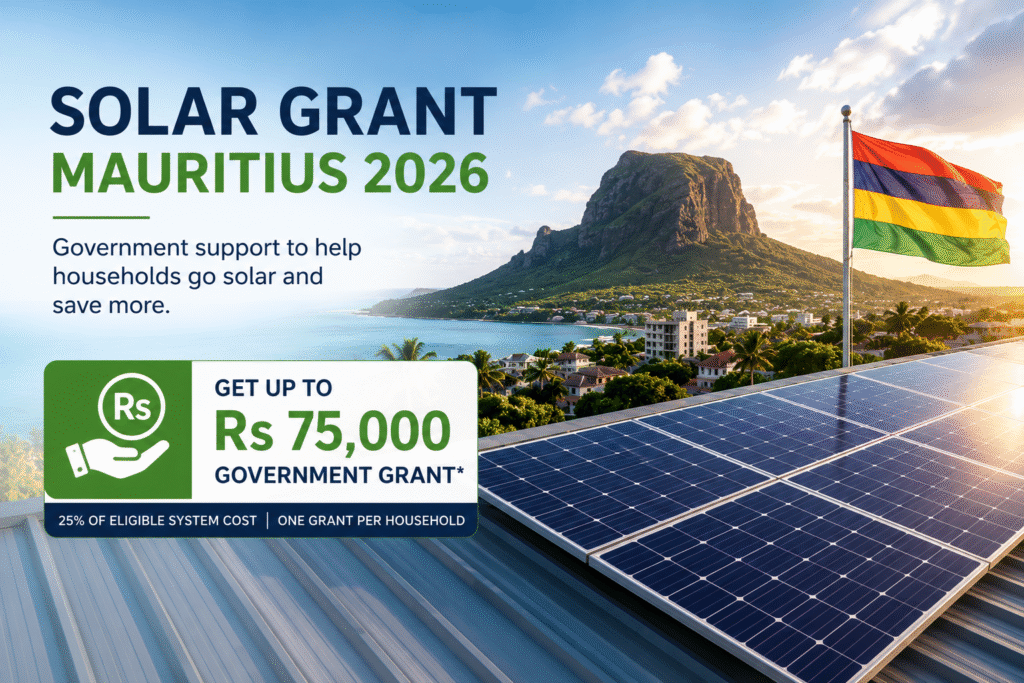
The Solar Grant Mauritius 2026 is one of the Government’s biggest initiatives to help households invest in rooftop solar while supporting Mauritius’ goal of reaching 60% renewable electricity by 2035. Mauritius has entered an important new phase in its transition towards cleaner, more secure and more locally generated electricity.
Reaching that target will require much more than a few large solar farms. It will require participation from households, businesses, industries, farmers, public institutions, NGOs, religious bodies, investors and renewable-energy professionals across the country.
The new Household Rooftop Solar PV Grant, launched on 25 July 2026, is therefore not an isolated measure. It forms part of a much wider programme of grants, green loans, tax incentives, CEB renewable-energy schemes, battery-storage investments and utility-scale projects intended to accelerate solar adoption while protecting the stability of the national grid.
At Enovra Energy Solutions, we welcome this national direction. Mauritius has an excellent solar resource, but achieving meaningful energy independence requires systems that are properly designed, safely installed and matched to the customer’s real electricity consumption and peak-load requirements.
Why Has Mauritius Set a 60% Renewable Energy Target?
Mauritius remains exposed to the cost and availability of imported fossil fuels. International conflicts, shipping disruption and changes in global fuel prices can therefore affect the cost of generating electricity locally.
Renewable electricity provides Mauritius with an opportunity to use more of its own natural resources—particularly solar energy—while improving national energy security, reducing exposure to international price volatility and lowering the carbon intensity of electricity generation.
The scale of the challenge should not be underestimated. According to the Economic Development Board, renewable energy accounted for approximately 18.2% of the electricity mix in 2024. The Government subsequently reset the national timetable, retaining the 60% objective but moving the target date to 2035 to support a more stable and realistic transition.
Closing that gap requires action at several levels simultaneously:
1. More household rooftop installations;
2. Greater solar adoption by businesses and industries;
3. Renewable-energy development on agricultural land;
4. Utility-scale solar, wind and floating-solar projects;
5. Significant investment in battery energy storage;
6. Stronger grid infrastructure; and
7. More efficient use of the electricity already being generated.
1. The Government Household Rooftop Solar PV Grant
The most visible new measure is the Government Household Rooftop Solar PV Grant, administered by the Development Bank of Mauritius on behalf of the Ministry of Energy and Public Utilities.
Eligible households may receive:
| Grant feature | Current provision |
| Grant percentage | 25% of eligible system cost |
| Maximum grant | Rs 75,000 |
| Maximum net monthly household income | Rs 150,000 |
| Number and allocation | One grant per household; first-come, first-served, subject to eligibility and funding |
The grant operates alongside the CEB Household Rooftop Solar Photovoltaic Scheme 2026. Applicants must register with the CEB, obtain the applicable Connection Agreement, secure an official quotation and submit their grant application through the DBM process.
The Government has allocated Rs 270 million from the Climate Sustainability Fund for the programme. If every approved household received the maximum Rs 75,000, that allocation would be equivalent to approximately 3,600 maximum-value grants. The actual number of beneficiaries may differ because individual grant amounts will depend on each eligible system’s approved cost.
Why the grant matters
The upfront purchase price remains one of the main barriers preventing households from investing in solar panels and battery storage. A 25% contribution can make a meaningful difference, particularly when combined with an appropriate financing arrangement.
However, the grant should not be treated as an invitation to increase solar prices.
| Enovra commitment: Enovra is committed to maintaining transparent and competitive pricing. Our core objective remains the same: making dependable solar technology more accessible through affordability, equipment quality, professional installation and responsible after-sales support. |
2. DBM Solar Financing for Households and Businesses
The grant covers only part of the system cost. The remaining balance may be paid from the customer’s own funds or financed through DBM or another financial institution.
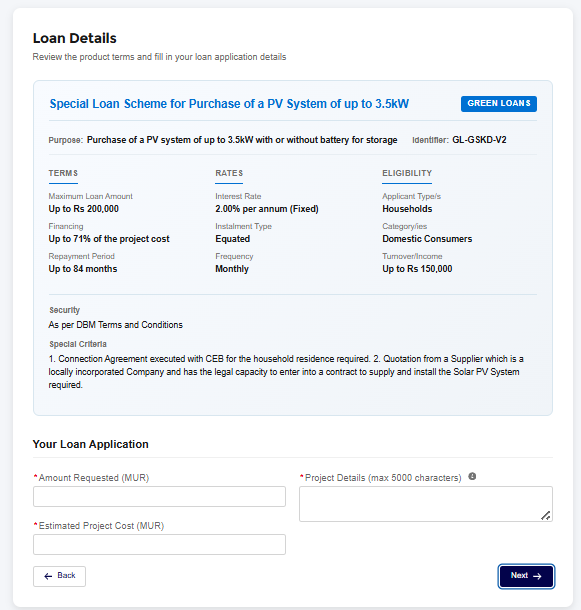
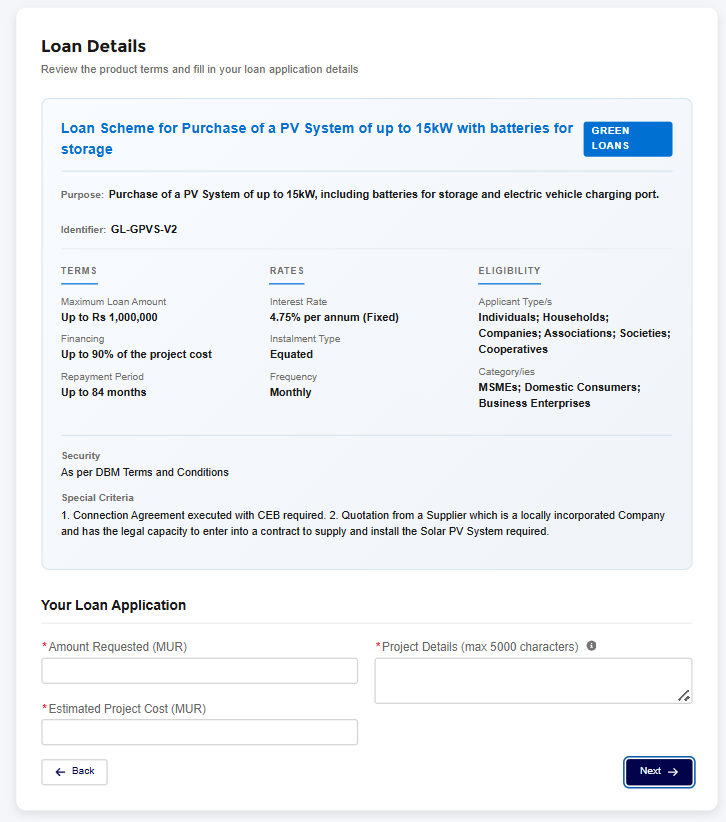
DBM currently provides separate solar-financing routes, including:
- A special loan facility for eligible PV systems of up to 3.5kW; and
- A loan of up to Rs 1 million for systems above 3.5kW and up to 15kW, including battery storage and, where relevant, an electric-vehicle charging port.
For the larger facility, DBM currently states that financing may cover up to 90% of project cost, with repayment over a maximum of seven years, subject to its approval, security requirements and terms.
It is important to distinguish between the two forms of support:
- The Rs 75,000 Government support is a grant, subject to approval and eligibility.
- A DBM solar loan is repayable finance and is not an additional grant.
A household may potentially use the grant together with an approved financing facility, but each component remains subject to its own application, documentation and approval process.
3. The CEB Household Rooftop Solar PV Scheme 2026
Financial support alone will not deliver the national transition. Solar installations also need a clear legal and technical route for connection to the CEB network.
The revamped CEB Household Rooftop Solar Photovoltaic Scheme 2026 combines key elements of earlier household net-metering and domestic solar schemes. It enables households to generate renewable electricity through an approved solar configuration and to participate under the applicable CEB metering arrangement.
Depending on the approved arrangement, a household may use solar electricity within the property and account for eligible surplus generation through the CEB connection.
Some important system rules include:
- Battery storage is mandatory for installations above 3.5kWac;
- Export above 5kWac requires a three-phase electricity configuration;
- Systems above 10kWac require a CEB Network Survey and Letter of Intent before installation;
- The maximum installation capacity is 50kW; and
- Maximum export is limited to 5kWac per phase.
These are important design considerations. The correct system cannot be determined simply by counting panels or dividing the value of a CEB bill by an assumed monthly production figure.
A professional assessment should consider:
- Daytime and evening electricity consumption;
- Simultaneous appliance use;
- Water heaters, air conditioners, pumps and other high-load equipment;
- Starting current and short-duration power surges;
- Existing single-phase or three-phase supply;
- Roof orientation, condition, shade and usable space;
- Required battery capacity and permitted depth of discharge;
- The customer’s preferred level of backup and energy independence; and
- The applicable CEB metering and export arrangement.
A system that is too small may fail to deliver the expected level of support. A system that is unnecessarily oversized can increase the capital cost without delivering a proportionate benefit.
4. Solar Tax Deductions and Investment Allowances
The Government also encourages renewable-energy investment through the tax system.
Solar Energy Investment Allowance for individuals
The Mauritius Revenue Authority’s published guidance provides for a Solar Energy Investment Allowance, under which an eligible individual may deduct the amount invested in a solar energy unit from net income, subject to the applicable income-tax rules.
For a qualifying couple, the allowance may be claimed by one spouse or divided between them in accordance with the MRA provisions.
This is a tax deduction—not a second cash grant. Its actual financial value will depend on the individual’s taxable income, tax rate and circumstances.
Annual allowance for businesses
MRA guidance also provides a 100% annual allowance for qualifying capital expenditure on the acquisition of a solar-energy unit. This can improve the tax efficiency of a commercial solar investment, although the final treatment depends on the company’s tax position and compliance with the applicable legislation.
Other incentives listed by the EDB
The Economic Development Board’s renewable-energy framework also lists measures such as:
- Zero-rated VAT and exemption from excise duty for photovoltaic systems;
- A 50% straight-line annual allowance for qualifying green-technology equipment;
- Land-conversion-tax exemption for eligible renewable-energy developments on agricultural land;
- Government Support Agreements to reduce risks associated with major renewable-energy projects;
- Exemptions relating to qualifying interest from approved green, sustainability or renewable-energy financing instruments; and
- The Premium Investor Certificate route for qualifying large, innovative or ESG-focused investments.
Not every incentive applies to every customer or project. Eligibility should therefore be confirmed with the relevant authority or professional tax adviser before a financial decision is made.
5. Free Solar Programmes for Qualifying Customers
Mauritius’s energy transition is not limited to households that can purchase their own systems.
CEB Home Solar Project Phase 2B
Under the CEB Home Solar Project Phase 2B, qualifying domestic customers can receive a solar PV kit installed free of charge. CEB bears the investment and operating and maintenance costs.
Eligible beneficiaries receive a monthly credit equivalent to 100kWh on their electricity bill for a period of 20 years, subject to the scheme’s conditions.
This is separate from the 25% Household Rooftop Solar PV Grant. It targets a different category of beneficiary and follows its own eligibility process.
NGOs and charitable institutions
The CEB Renewable Energy Scheme for NGOs and Charitable Institutions provides qualifying organisations with free PV installations. CEB bears the investment and maintenance costs, while the beneficiary receives a monetary credit corresponding to 50% of the energy generated and exported, for 20 years under the current scheme terms.
Religious bodies
A similar programme exists for eligible religious bodies. The current phase targets at least 4MW of cumulative solar capacity, with free installation and CEB-funded operation and maintenance. Qualifying beneficiaries receive a credit corresponding to 50% of the electricity produced and exported for 20 years.
Together, these programmes demonstrate that the renewable-energy strategy is intended to reach households and community institutions that may not otherwise have the capital to purchase a private solar installation.
6. Commercial, Industrial and ICT Renewable-Energy Schemes
Businesses account for a significant part of national electricity demand. The 60% target therefore cannot be achieved through household rooftops alone.
Carbon Neutral Commercial Sector Scheme
The Carbon Neutral Commercial Sector Renewable Energy Scheme is being offered on a pilot basis to major commercial electricity customers under the applicable tariff categories. It is intended to facilitate solar investment by the commercial sector as part of the 2035 strategy.
Carbon Neutral Industrial Sector Scheme
Under the Carbon Neutral Industrial Sector Scheme, an aggregate capacity of 100MW has been earmarked for eligible industrial renewable-energy projects. CEB states that applications for projects of up to 2MW are still being entertained under the present process.
ICT Sector Carbon Neutral Scheme
The ICT-sector scheme supports eligible solar and wind projects by customers in the specified ICT tariff categories. The current framework earmarks 20MW of cumulative capacity in Mauritius.
Solar-powered EV charging
CEB also maintains renewable-energy schemes connected with electric-vehicle charging for qualifying domestic, commercial and industrial customers supplied through the low-voltage network. The EDB framework separately lists tax incentives relating to qualifying fast-charging infrastructure and electric mobility.
These measures connect the electricity transition with the gradual electrification of transport.
7. Agrivoltaics: Supporting Both Energy and Food Security
Solar development in Mauritius must take account of the country’s limited land resources and its need to maintain agricultural production.
Agrivoltaics allows solar generation and agricultural activity to take place on the same land. Properly planned projects can provide renewable electricity while preserving productive use of agricultural sites.
Under the current CEB Agrivoltaics II Scheme:
- 40MW of cumulative capacity has been earmarked for Mauritius;
- A further 2MW has been earmarked for Rodrigues;
- Eligible projects are intended for registered planters and farmers;
- Hybrid projects generally fall within the 500kWac to 4MWac range; and
- Battery energy storage forms part of the scheme’s technical structure.
The final approved capacity remains subject to CEB network assessment and the applicable scheme requirements.
A practical example is the 4.8MWp OmniPV1 agrivoltaic facility inaugurated at Poudre d’Or in June 2026. The project is expected to generate approximately 7,700MWh of renewable electricity annually while maintaining the connection between energy development and agricultural land use.
8. Utility-Scale Solar and Battery Storage
Distributed rooftop systems are only one side of the transition. Mauritius also requires large renewable-energy facilities capable of supplying substantial volumes of electricity to the national grid.
CEB’s current procurement programme includes requests for proposals for:
- Ten 10MWac hybrid renewable-energy facilities, combining solar PV and battery energy storage; and
- Three 40MWdc hybrid solar and battery facilities.
These projects show the increasing importance of storage. Solar generation varies according to time of day and weather conditions. Battery systems can help manage intermittency, move part of the generated energy into higher-demand periods and support a more stable electricity network.
The wider Government energy reset has also identified prospective projects including:
- A 17.5MW floating solar facility at Tamarind Falls with a 12MW battery;
- Additional solar farms incorporating storage;
- Expanded agrisolar capacity;
- Revival of wind generation at Plaine des Roches; and
- Further grid-scale battery capacity.
The Government has indicated that these programmes could add approximately 277.5MW of renewable capacity.
9. The Roles of MARENA, EEMO, EDB, DBM and CEB
Mauritius’s renewable-energy transition involves several public bodies, each with a different role.
Ministry of Energy and Public Utilities: The Ministry leads national energy policy and oversees several of the institutions involved in implementation.
Central Electricity Board: CEB manages the electricity network, technical interconnection requirements, inspections, metering arrangements and the various customer and project-specific renewable-energy schemes.
Development Bank of Mauritius: DBM administers the household grant process on behalf of Government and provides green-financing facilities for qualifying solar investments.
Economic Development Board: EDB promotes investment in the renewable-energy sector, explains the available fiscal and investment incentives and facilitates larger or strategically significant projects.
Mauritius Revenue Authority: MRA administers the tax deductions, annual allowances and other applicable fiscal provisions.
Mauritius Renewable Energy Agency: MARENA’s statutory role includes promoting renewable-energy adoption, advising Government on renewable-energy policy and strategy, supporting enabling frameworks, evaluating projects and helping increase renewable energy’s share in the national energy mix.
Energy Efficiency Management Office: EEMO develops energy-efficiency strategies, monitoring procedures, standards, labelling requirements and guidance for households, buildings, services and industry.
This last point is important: Mauritius cannot reach a secure and affordable energy future through generation alone. Reducing unnecessary electricity consumption and using energy more efficiently are equally important.
What Does This Mean for Mauritian Households and Businesses?
The current policy direction creates more routes into renewable energy than Mauritius has previously offered.
However, the existence of a grant, loan or tax allowance does not automatically mean that every solar investment is financially or technically suitable.
Before proceeding, customers should determine:
1. Which CEB scheme applies to the property;
2. Whether the customer satisfies the relevant eligibility criteria;
3. Whether grant funding remains available;
4. How much of the project can be self-funded;
5. Whether loan repayments are affordable;
6. Whether the applicant can benefit from the available tax allowance;
7. Whether the property requires single-phase or three-phase work;
8. What battery capacity is genuinely needed;
9. Whether the roof and electrical installation are suitable; and
10. Whether the proposed equipment has adequate warranties and local after-sales support.
The objective should not be to install the greatest number of panels possible. It should be to design a safe, compliant and financially sensible system that supports the customer’s actual consumption pattern.
Enovra’s Role in the Transition
Government, CEB, DBM, MRA, EDB, MARENA and EEMO are creating the policy, regulatory and financial environment for renewable-energy adoption.
Companies such as Enovra must convert those policies into properly functioning installations.
Enovra supports its customers through:
- Preliminary electricity-consumption and peak-load assessment;
- Solar-panel, inverter and battery sizing;
- Review of roof and electrical conditions;
- Preparation of the official system quotation;
- Guidance through the CEB and DBM process;
- Supply and professional installation;
- Testing, protection and commissioning;
- Preparation of CEB completion documents;
- Coordination of the technical inspection process; and
- Local monitoring and after-sales support.
| Our position is straightforward. Government support should make solar more affordable—not provide an excuse for suppliers to inflate their prices. Enovra remains committed to competitive pricing, dependable equipment, responsible system design and customer support before, during and after installation. |
Frequently Asked QuestioFAQ – Frequently Asked Questionsns
What is the Government solar grant in Mauritius?
Eligible households may receive 25% of the approved cost of a qualifying rooftop solar PV system, up to a maximum grant of Rs 75,000. Approval is subject to the scheme criteria, household-income limit, funding availability and the DBM process.
How many households can receive the grant?
Government has allocated Rs 270 million. If every applicant received the full Rs 75,000, this would fund approximately 3,600 households. The actual number may differ depending on the grant awarded to each approved applicant.
Can the grant be combined with a DBM loan?
The grant and loan are separate facilities. An eligible applicant may potentially finance the remaining balance through DBM or another approved financier, subject to the relevant lender’s assessment and terms.
Is a battery compulsory under the CEB household scheme?
Battery storage is mandatory for household installations above 3.5kWac under the current scheme rules. The exact configuration should be confirmed against the customer’s CEB agreement and system size.
Are there tax benefits for purchasing solar panels in Mauritius?
MRA guidance provides a Solar Energy Investment Allowance for eligible individuals and a 100% annual allowance for qualifying business expenditure on a solar-energy unit. The benefit depends on the taxpayer’s circumstances and should not be confused with a cash grant.
Are there renewable-energy schemes for companies and farmers?
Yes. CEB currently maintains or is implementing schemes for commercial customers, industrial operators, the ICT sector, agrivoltaic developers, public institutions and electric-vehicle charging, each with separate eligibility and technical requirements.
Start With a Proper Solar Assessment
The Household Rooftop Solar PV Grant creates an important opportunity, but customers should begin with a realistic assessment of their electricity needs—not with a preselected number of panels.
Send Enovra your latest CEB bill. Our team will assess your consumption, likely peak demand, roof conditions, inverter requirements and battery-storage needs before recommending an appropriate system.
| READY TO Contact Us START? Send us your latest CEB bill and our team will guide you through the next steps. | ENOVRA 218 3816 | 5919 0993 info@enovra.mu |